SDGs Key To Attainment Of Economic Cooperation Among Governments Globally-Osinbajo
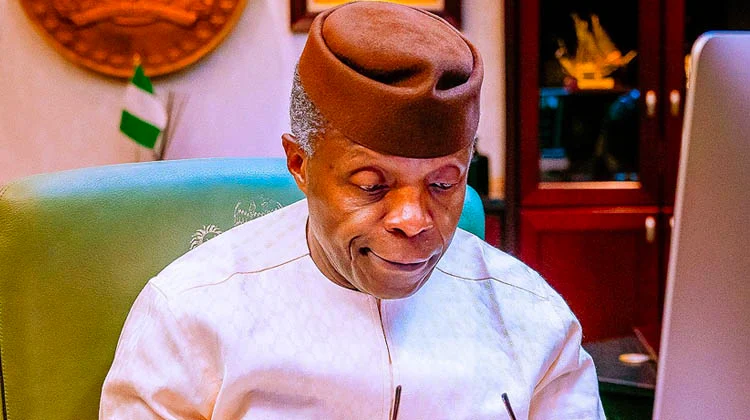
In his words: “The genesis of Agenda 2063 was the realisation by African leaders that there was a need to refocus and reprioritise Africa’s agenda from the struggle against apartheid and the attainment of political independence for the continent, it is also an arrangement that prioritises inclusive social and economic development, continental and regional integration, democratic governance, peace and security among other issues.
The objective of which is to reposition Africa to becoming a dominant player in the global arena.”
Referring to the 2030 Agenda for sustainable development, Prof. Osinbajo said: “As you may be aware, the 2030 Agenda for sustainable development adopted by all UN member states in 2015, provides a shared blueprint for peace and prosperity for people and the planet, now and into the future.
At its heart are the 17 SDGs, which are an urgent call for action by all countries, both developed and developing in a global partnership.”
This, according to him, is “to recognise that ending poverty and other deprivations must go hand in hand with strategies that improve health and education, reduce inequality, and spur economic growth while tackling climate change and working to preserve our oceans and forest.
Still, on SDGs, Prof. Osinbajo further said that the SDGs had remained cardinal to the attainment of robust economic cooperation among governments globally, particularly in the realisation of the decade of action for SDGs as defined by the UN. “You will agree with me that the strategic partnership embedded in the SDGs has availed Nigeria a huge implementation context due to its large population, landmass and ethnic diversity.
“To achieve the SDGs and their effective implementation, Nigeria has established six SDGs innovation hubs, one in each geo-political zone; this provides an opportunity for states to leverage and dialogue with all relevant stakeholders to accelerate innovative solutions, prioritising social protection as a tool to overcome the bottlenecks and expanding financing options to accelerate the achievement of SDGs in Nigeria.
“Since the adoption of the African Union (AU) Agenda 2063 and the UN Agenda 2030, the Nigerian government has embarked upon a process of domesticating these agendas at the national and sub-national levels. Interestingly, the new National Development Plan (NDP) 2021-2025 has strategies that aim at achieving the targets set under each of the goals in both Agendas,” he disclosed.
According to him, the government of Nigeria has been proactive in addressing the effects of the COVID-19 Pandemic.
He assured that Nigeria has attained a landmark even amid the slowdown of economic activities arising from the COVID -19 pandemic.
“In addressing the gaps created by the pandemic, the National Economic Recovery and Sustainability Plan of government was introduced to cushion some of the hard effects of the global meltdown. Other strides achieved in the country included the efforts at improving food security and nutrition through a multi-sectoral plan for food and nutrition.
He said that the medium-term National Development Plan 2021-2025 has been launched and is in the public domain while the long-term National Development Plan tagged Nigeria Agenda 2050 is in the process of completion.
About The Author