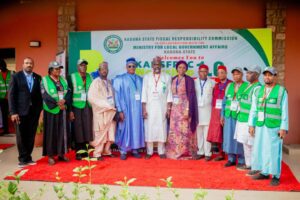
FG Biosafety Agency Holds Sensitization Workshop to Deepen Stakeholders’ Experience in Abuja
As part of the effort to enlighten Nigerians on the safety of genetically modified organisms (GMOs)
in the Country, the National Biotechnology Development Agency(NABDA), and Open Forum on Agricultural Biotechnology(OFAB) held a one-day workshop for medical practitioners on Wednesday, 2023 in Abuja.
Speaking at the workshop, the Director General of NABDA, Prof Abdullahi Mustapha, has called on medical practitioners and other critical stakeholders to support the federal government’s drive in enhancing food productivity and availability by collaborating with NABDA to deepen Nigeria’s biotechnology experience, noting that the country requires modern technology for an increased and sustainable food production.
The DG said that it was important that medical practitioners who have daily contact with the people be educated on all the safety gauges put in place by the government to ensure that the deployment of the technology does not harm Nigerians and the environment.
“It is important that medical practitioners are at the forefront of this discussion given the pivotal roles they play in patient care and other essential parts of the country’s healthcare system,
“Nigeria is faced with challenges of rapid population growth and urbanization hence the need to double food production by 2050; in essence, Nigeria is growing poorer, and the agricultural environment is deteriorating. Seed varieties perform low and are obsolete and do not correspond to the new climatic factors. There is high pressure of insect pests and diseases. Soil fertility is low and there is a lack of capital funding for investments,” he said.
Stating that biotechnology deployment in Nigeria has yielded enormous fruits, given several GM crops that have been successfully developed and commercialized, while a good number of others are at various stages of development.
Abdullahi emphasised that modern biotechnology practice which uses genetic modification tools, will provide safer, cheaper, better quality, less waste, less energy, more environmentally friendly, and more sustainable products.
Hence, the application of biotechnology to agriculture will ensure the production of significantly more food on less land, with less water in conditions of increasingly unpredictable climate and markets, with less manual labor as well as reduce the amount of waste and losses and produce more nutritious and safe food.
At the workshop presentation, Dr. Rose Gidado, Director, the Department of Agricultural Biotechnology at NABDA said the workshop is expected to bridge all existing information gaps between agricultural scientists and medical practitioners on the activities of GMOs.
Dr. Gidado noted that scientists through biotechnology have succeeded in using living organisms and biological processes to improve life on earth, adding that biotechnology application has become very necessary in almost all sectors of the economy, especially in the health sector where various vaccines are saving lives.
According to her “the application of biotechnology cuts across various fields ranging from medicine to industry, environment, and agriculture, among these sectors, agriculture is the most important, because agriculture provides food without which humans cannot survive in addition to serving as the resource factor for other sectors including medicine, industry, and environment.”
Also speaking, the regional director, of the African Agricultural Technology Foundation(AATF) Dr. Jean Baptiste, the Assistance Director of the Program for Biosafety Systems(PBS), Amsterdam, Netherlands, Former Director General, of NCDC, Abuja, Prof. Nasidi Abdulsalami in their goodwill message called on citizens noting the benefits of biotechnology and products of biotechnology especially GMOs as the National Biosafety Management Agency is always up and doing to ensure that biotechnology is applied only in a manner that is safe for human health and also for the environment.
The workshop aims to provide a comprehensive understanding of the science behind genetic modification, its role in modern medicine, potential benefits in agricultural productivity and food nutrition as well as the regulatory procedures being followed to ensure the safety of the emerged products.
The one-day sensitization workshop was organized in collaboration with relevant Stakeholders and Regulators, Including, the Program for Biosafety Systems(PBS), African Agricultural Technology Foundation (AATF) Nigerian Medical Association (NMA) National Biosafety Management Agency(NBMA), National Agricultural Seed Council(NASC), National Agricultural Quarantine Service(NAQS), Federal Competition and Consumer Protection Council(FCCPC).
About The Author