FCMB MD Advocates for Bank Recapitalisation to Boost Nigeria’s Private Sector Credit Above 13%
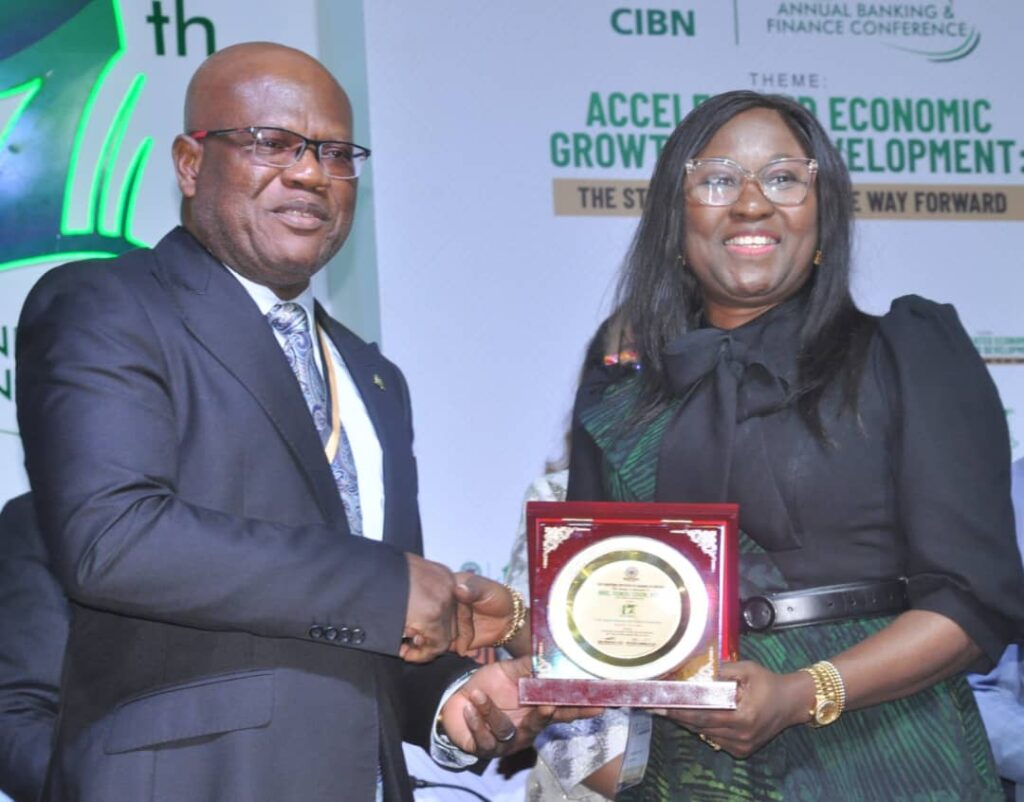
Managing Director of First City Monument Bank (FCMB), Mrs Yemisi Edun, receiving an award from the President/Chairman of Council, the Chartered Institute of Bankers of Nigeria (CIBN), Professor Pius Olanrewaju, during the Banking & Finance Conference in Abuja…recently
Samuel Mobolaji
Nigeria’s private sector is grappling with a significant credit shortfall, with domestic lending currently standing at just 13 per cent of Gross Domestic Product (GDP), a stark contrast to the global average of approximately 80 per cent.
This discrepancy poses a considerable challenge to the nation’s economic growth, especially when compared to trillion-dollar economies that enjoy robust private sector lending.
Yemisi Edun, the Managing Director of First City Monument Bank (FCMB), addressed this pressing issue during the 17th Annual Banking and Finance Conference in Abuja.
She emphasized that recapitalisation would enhance banks’ capacity to provide affordable loans to SMEs, enabling these businesses to thrive and make a more significant contribution to GDP.
Edun further elaborated on the necessity of growing the financial services sector faster than the economy itself to achieve Nigeria’s ambition of becoming a $1 trillion economy.
Currently, financial services account for about 4.7 per cent of GDP, and to reach a target of 5.5 per cent by 2030, the sector must grow by more than 18 per cent annually.
The ongoing recapitalisation, which is projected to increase the banking sector’s shareholders’ funds by over 50 per cent, will be instrumental in driving this growth.
“A larger capital base will position banks to meet the financing needs of critical sectors, including infrastructure and manufacturing, both essential for Nigeria’s long-term economic prosperity,” she explained.
In addition to traditional lending, Edun advocated for the exploration of alternative financing mechanisms, such as joint ventures, venture capital, and loan guarantee schemes, to support high-potential SMEs.
“Diverse funding options, including equity and debt partnerships, are vital for overcoming the capital constraints faced by many businesses,” she advised.
Edun also addressed the urgent need for infrastructure financing, stating that Nigeria requires approximately $100 billion annually to tackle its infrastructure deficit.
She urged banks to collaborate on issuing long-term infrastructure bonds and forming public-private partnerships (PPPs) to facilitate this funding.
Moreover, Edun pointed out Nigeria’s low deposit-to-GDP ratio, currently at 15 per cent, compared to a global average of 50 per cent.
She called on banks to enhance financial inclusion by expanding agency banking in underserved areas and developing tailored savings products to mobilise more deposits.
Looking to the future, Edun stressed the importance of investing in technology and human capital.
“Digital transformation and automation are essential for the future of financial services. Innovations such as artificial intelligence will be key to improving efficiency and broadening access to underserved populations,” she stated.
About The Author