Rite Foods Slams Mamuda with N1.6bn Lawsuit over Fearless Trademark Infringement
Samuel Mobolaji
In a bold move to defend its intellectual property rights, Rite Foods Limited, manufacturers of the popular Fearless Energy Drink, has filed a N1.6 billion lawsuit against Mamuda Beverages Nigeria Limited, makers of Pop Power Energy Drink, over allegations of trademark infringement and product imitation.
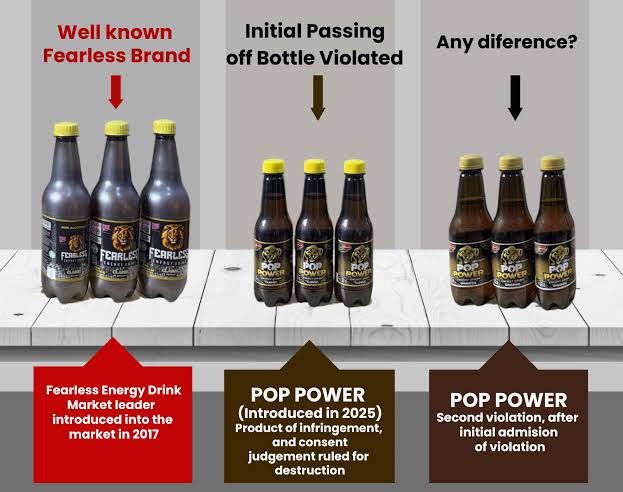
The suit, filed on April 14, 2025, before Justice Emeka Nwite of the Federal High Court, Abuja Division (Suit No: FHC/ABJ/CS/705/2025), is the latest development in a protracted dispute between both companies over the striking similarity between Pop Power and Fearless energy drinks in terms of design, bottle shape, labeling, and overall appearance.
Rite Foods, through its legal team led by Oyetola Oshobi and Boonyameen Lawal, is seeking ten reliefs, including the payment of N1.6 billion in damages and a perpetual injunction restraining Mamuda from producing any energy drink that bears resemblance to Fearless.
The plaintiff cited its registered trademark number 38227 and design registration NG/DS/NT/2020/1099 as being violated by Mamuda, a Lebanese-owned company based in Kano.
This legal action follows a previous case filed in January 2025, where the Federal High Court, Abuja, granted injunctive reliefs and Anton Piller orders against Mamuda for infringing on Fearless’s trade dress. Mamuda eventually opted for a consent judgment, admitted wrongdoing, and agreed to destroy the infringing Pop Power products, an exercise verified with visual and pictorial proof.
However, Rite Foods alleges that Mamuda has since circumvented the consent agreement by reintroducing Pop Power with only cosmetic adjustments that continue to cause consumer confusion.
According to market feedback, the new version of Pop Power is still being informally referred to as “small Fearless”, blurring the lines between the two brands.
“This situation undermines judicial integrity and the effectiveness of Nigeria’s IP enforcement framework,” a source within Rite Foods said. “Our concern is not just about competition, but consumer protection and brand dilution.”
Contrary to misinterpretations in some media outlets, Rite Foods clarified that its latest ex parte motion was not denied, but the court is first hearing a preliminary objection by Mamuda a procedural matter not related to the merits of the case.
While Rite Foods insists that Mamuda’s actions amount to a “deliberate infringement and deceptive market practice,” Mamuda has labeled the latest legal move as corporate bullying, claiming it had already complied with the initial court ruling.
Reacting to the development, Barrister Aisha Lawal, a Lagos-based intellectual property lawyer, said the suit underscores the importance of trademark enforcement in protecting brand integrity in Nigeria’s fast-moving consumer goods sector.
“Rite Foods has every legal right to approach the court to seek redress if it believes its registered trademarks and trade dress are being infringed upon,” Lawal said.
She explained that under the Nigerian Trademarks Act and common law principles of passing off, no company is permitted to ride on the goodwill of another by producing similar-looking products that could cause confusion in the market.
“From what I’ve seen, the resemblance between the two products could likely mislead consumers, especially in areas with lower brand awareness. If proven in court, this would amount to a classic case of passing off,” she added.
Lawal emphasized that consent judgments are binding, and any violation—direct or indirect—could lead to contempt proceedings or fresh legal actions. She also urged Nigerian manufacturers to invest in distinctive branding and respect intellectual property laws, noting that failure to do so discourages innovation and undermines fair competition.
Meanwhile, industry stakeholders and consumer rights advocates have also weighed in, expressing concern over the implications of the dispute on brand trust and consumer protection.
Mr. Tunde Okonjo, a board member of the National Association of Food and Beverage Manufacturers (NAFBEM), described the situation as “worrisome” and stressed the need for stronger enforcement of intellectual property rights in Nigeria.
“Manufacturers invest heavily in branding, packaging, and building consumer loyalty. When another company introduces a lookalike product, it doesn’t just confuse consumers — it undermines years of marketing investment and trust,” he said.
Echoing similar concerns, Mrs. Funmi Olorunsola, a consumer advocacy expert and founder of the Buy Right Nigeria Initiative, stated that the ongoing case is not only about legal rights but also about consumer clarity and product safety.
“Consumers rely on visual cues when choosing products. If two energy drinks look nearly identical, it becomes easy for even well-informed buyers to make mistakes. This isn’t just a legal matter; it’s a consumer rights issue,” she noted.
She urged regulatory bodies like NAFDAC and the FCCPC to step in where necessary to protect the public from deceptive product presentations that erode market transparency.
Rite Foods has reaffirmed its commitment to innovation, originality, and respect for the law, noting that genuine business growth must be built on creativity, not imitation.
The legal battle underscores a broader concern about how Nigerian courts handle trademark violations and the willingness of businesses to respect judicial decisions in a competitive marketplace.
About The Author