Naira stables as currency in circulation decline to N3.24trn
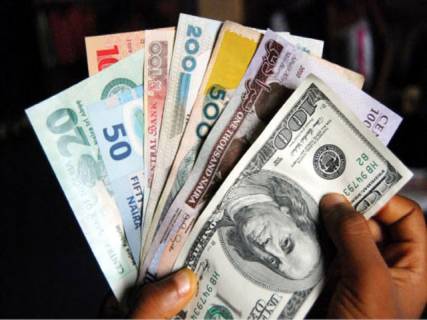
The Nigerian currency, Naira, stood steady at N418.33 to a dollar at the close of the official trading activities last week, even as the currency in circulation declined by N4.59billion or 0.14 per cent to N3.24 trillion from N3.25 trillion in February 2022.
According to data published by FMDQ, where forex is officially traded, the naira exchanged officially with the dollar in the past three months. Its lowest was on January 5 when it closed at N422.67 to a dollar.
Within the past three months, the local unit has been hovering within the range of N416.00– N417.00 and above the mark amidst fluctuating forex supply and market sentiments.
The naira, which opened trading at N418.25 per $1, reached an intraday high of N410.00 and a low of N444.00 before closing for the week at N418.33.
At the parallel market in Lagos and Abuja, dealers exchanged the naira at N583.00 and sold at N585.00 to a dollar.
Consequently, the Central Bank of Nigeria (CBN) in its Money and Credit Statistics had reported N3.29 trillion in circulation in January 2022.
Nigeria’s currency circulating in the economy has recorded significant growth since the Central Bank maintained its dovish monetary approach as a means to ensure the recovery of the nation’s economy, following the recession recorded in 2020, caused by the covid-19 pandemic.
Meanwhile, while reacting to the recent criticisms of Nigeria’s multiple exchange rates and suggestion of the floating the Naira, the Governor of, the Central Bank of Nigeria (CBN), Mr Godwin Emefiele, explained that Nigeria cannot float its currency, Naira, now to avoid an exchange rate spiral.
Emefiele pointed out that the fuel subsidy will be removed by 2023 when Dangote Refinery becomes fully operational.
He noted that the policy of the government is to ensure a managed float of the Naira as opposed to the proposal of the World Bank for the currency to freely float. A free-floating exchange rate is a flexible exchange rate system solely determined by market forces of demand and supply of foreign and domestic currency, and where government intervention is inexistent.
“On the other hand, a managed floating exchange rate is an exchange rate regime in which the exchange rate is neither entirely free (nor floating) nor fixed. Rather, the value of the currency is kept in a range against another currency by central bank intervention.
“Even at our private meetings, what we come up with is to say look, we realise that different countries have different challenges, what we do expect is for you to go back and develop a homegrown solution that helps your situation”, he said.
According to him, “Let me say that Nigeria is on a managed float. What that also means is that we cannot adopt what is being proposed that we go on a free float of the currency. Doing that will create an exchange rate spiral for Nigeria as long as the demand surpasses the supply of foreign exchange in Nigeria.
“We have been at this since 1986 and that is why we are saying whereas we are doing something to adjust the currency, like for instance between 2015 and now, you will observe that we have adjusted the currency from about N155/USD to about N410, N420 that it is today. So, we cannot be accused of not adjusting the currency.
“But we are trying to adopt a very gradual approach towards adjusting the price to the level that it is today. But at the same time, we have to be given the chance to also look at while you are adjusting the price, you must also do something about demand and supply”, he added.
About The Author