Battle of SUVs: Hyundai Tucson vs Honda CR-V
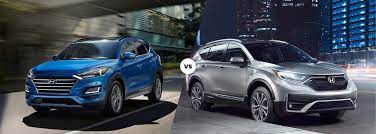
When you are considering buying a compact SUV car, some of the brands that come to your mind are Hyundai Tucson and Honda CR-V. The two brands have their difference and their brand reputation and features.
All compact SUVs are the same, every model and every manufacturer has its priorities, and however, people often purchase compact SUVs for their reliability or to make their families feel safe.
Honda and Hyundai are two well-known car brands that have many admirers. If you can’t decide what vehicle to buy, these comparisons will help you to determine which of the two brands is designed especially for you.
Honda is a Japanese brand with a long history, starting in 1946. It is now an international industrial company known primarily as a manufacturer of the most reliable automobiles and motorcycles.
Hyundai was founded in 1947. Its name is translated from Korean as modernity. The company became involved in the automotive industry in the late 60s and took the leading position in the Korean auto market.
Hyundai Motors rightfully bears the name of one of the world-leading car manufacturers aiming to enrich people’s lives with technologies and innovations.
The differences in Hyundai and Honda brand philosophy determine the main characteristics of their car models, from appearance to price.
Honda has a reputation for producing safe and reliable cars, while Hyundai is known for offering affordable vehicles with advanced technology and safety features.
Hyundai vehicles are sold at a more affordable price than their Honda counterparts.
The differences between the two are so slight that subjective desires such as style, handling, and brand loyalty could easily swing the decision to the CR-V.
Both compact SUVs come with an array of standard driver-assistance features such as lane-keeping assist, lane-departure warning, forward-collision mitigation, and adaptive cruise control. You’ll find blind-spot monitoring on all Tucsons, but the base CR-V does without it.
The 2023 Hyundai Tucson offers a series of driving assistance systems surely more complete than the CR-V. Technologies like Forward Collision-Avoidance Assist, Blind-Spot Collision-Avoidance Assist, Lane Keeping Assist, and Rear Cross-Traffic Collision-Avoidance Assist are an example. These features are a great help for the driver and allow for a more reliable overall driving experience. They help prevent accidents and thus keep passengers and families safe.
The Hyundai Tucson model SEL and XRT are also equipped with essential alarm systems for parents, the Ultrasonic Rear Occupant Alert (Ultrasonic ROA). It is able to detect the presence of passengers (or even our loyal pets) in the rear seats and then helps the driver control the vehicle before getting off. The Honda CR-V, on the other hand, puts a lot less on the table, in terms of advanced safety features, which could be an important factor to consider.
For a family-friendly SUV, Hyundai Tucson has a family-friendly technology which is an important factor to consider. First, the Tucson allows you to use a digital key to access and turn on the car, which the CR-V does not offer. In addition, the rear handle does not need to be touched to open the trunk, so if you have dirty or busy hands, this will automatically open for you.
As you know, children can be quite reckless at times, and sometimes they get out of the vehicle without checking properly that the road is safe. For this reason, the Tucson is equipped with an alarm system – Safe Exit Warning (SEW) – that warns passengers about to get off of any incoming dangers. We’re sure you can understand the importance of such a feature to keep your kids safe.
The Hyundai Tucson is equipped with a 10.25-inch touchscreen display with integrated navigation and Bose Premium Audio System. Android Auto and Apple wireless CarPlay are available on both cars. These are extra features, but they guarantee a more fun and engaging experience for all families.
To make the trip enjoyable for everyone, the Korean car offers a 60/40 split-folding rear seatback, cloth seating surfaces, steering-wheel-mounted audio and cruise controls, Bluetooth® hands-free phone system, and many other features.
Due to its greater headroom and legroom Hyundai Tucson allows passengers in the backseat to be able to stretch out a lot more than in the Honda CR-V.
In terms of towing capacity, the Hyundai Tucson is the choice over the Honda CR-V for pulling heavy loads. In terms of horsepower, it’s a virtual tie between the Honda CR-V and the Hyundai Tucson.
In terms of power, the two cars are very similar. We’re talking about a 187 hp Inline 4-cylinder engine for the Hyundai Tucson and a 190hp for the Honda CR-V.
In terms of seating, you’ll be able to fit about the same number of people in both the Honda CR-V and the Hyundai Tucson. The Honda CR-V has less cargo space than the Hyundai Tucson.
The Honda CR-V still has a good number of technological features: the Lane Watch, for example, is a system that projects a feed from the left exterior rearview camera onto the dashboard display. However, the Honda is not equipped with all the Tucson’s advanced driver assistance systems.
Honda vehicles are at the top of most car categories, except for some models. In contrast, all Hyundai hybrid models are excellent in quality.
Honda is considered the best in both the small and medium car categories. In addition, the used Honda CR-V outperforms the used Hyundai Tucson in the compact SUV category.
As a whole, Hyundai vehicles are more fuel-efficient, and you will spend less on repairs and maintenance thanks to Hyundai’s long-term warranties.
Warranties
Hyundai offers the most longstanding warranty in the entire automotive industry. So there is no way Honda can beat Hyundai in this section.
New car warranty, Hyundai provides a 5-year / 60,000-miles warranty for all their cars, while Honda – 3 years / 36,000 miles.
Drivetrain
With Hyundai, you get ten years / 10,000 miles of limited warranty. Honda offers 5-year / 60,000 miles.
Hybrid Battery
While Hyundai is well-known for its Lifetime Hybrid Battery Warranty, Honda owners get only eight years or 100,000 miles of limited warranty.
Roadside Assistance
Both Honda and Hyundai offer roadside assistance services. However, Hyundai leaves Honda behind again by offering 5-year roadside assistance for unlimited miles. Honda offers roadside assistance for three years or 36,000 km.
Corrosion guarantee. If you compare these brands in terms of corrosion guarantees, both brands offer unlimited miles. For Honda vehicles, it lasts five years, while Hyundai provides this warranty for seven years.
Hyundai Tucson is one of the most reliable SUVs on the market. And it edges over the Honda CR-V in technology, styling, and comfort.
About The Author