FG secures Chinese commitment for power equipment industrial park
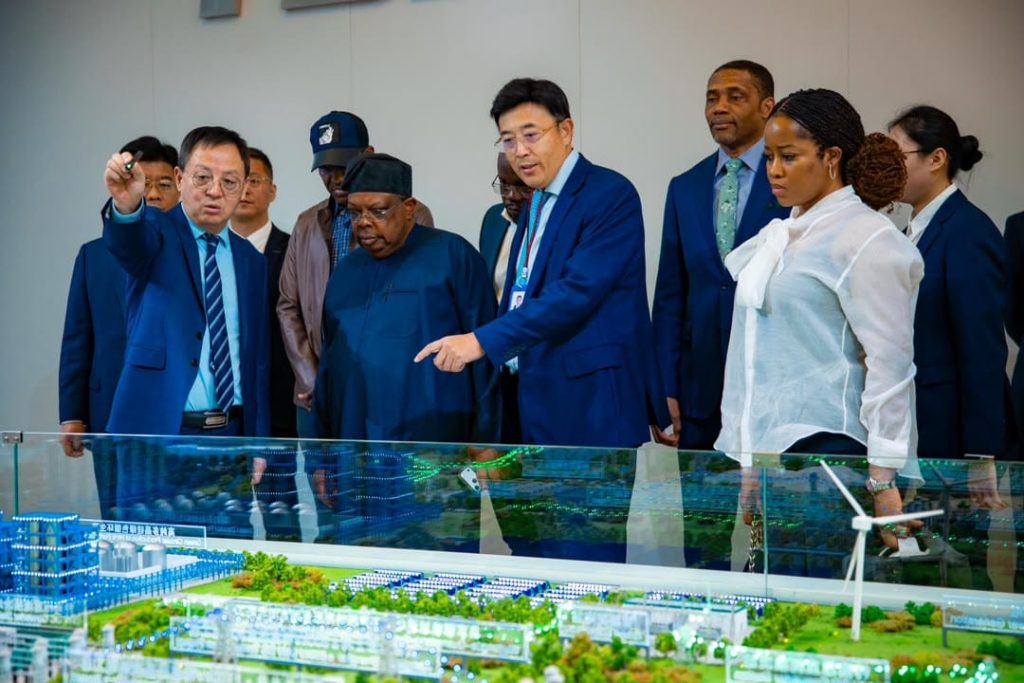
The Federal Government has secured a commitment from Chinese power equipment manufacturer, TBEA, to establish a power and energy equipment industrial park in Nigeria, in a move aimed at reducing the country’s dependence on imported electricity infrastructure while creating a domestic manufacturing base for the sector.
The commitment was secured by the Minister of Power, Joseph Tegbe, during a high-level engagement with TBEA in Beijing as part of Nigeria’s broader push to deepen Chinese participation in the power value chain.
The proposed industrial park is expected to manufacture critical equipment for the electricity industry, develop local suppliers, transfer technology and create jobs, while potentially positioning Nigeria to serve emerging equipment markets across Africa.
The initiative comes as the Federal Government seeks to move beyond the traditional model in which Nigeria imports much of the equipment required to expand its transmission and distribution networks. Tegbe said the government wants Chinese partners to become long-term development partners capable of bringing capital, technical expertise, skills and productive capacity into the country.
For the economy, local production of transformers, transmission equipment and other power-sector components could reduce import dependence, retain more value within Nigeria and create opportunities for manufacturers and smaller businesses to participate in the electricity supply chain.
Tegbe also secured renewed commitment from TBEA to accelerate ongoing transmission and distribution projects under the Presidential Power Initiative (PPI), including infrastructure expected to help unlock more than 2,000 megawatts of stranded generation capacity and improve bulk electricity supply to the Federal Capital Territory.
The minister pressed the company to complete projects that are already substantially developed, arguing that delays in bringing completed or near-completed infrastructure into operation continue to deprive households and businesses of the economic benefits of existing investments.
The demand for faster infrastructure delivery is particularly significant for manufacturers and other businesses whose operating costs remain high because of unreliable grid supply and dependence on alternative power sources. Additional transmission capacity could therefore support lower energy costs and improve the productivity of industries once the associated generation is effectively delivered to consumers.
Tegbe also called for planned grid expansion to cover the East-West corridor as the government seeks to increase transmission capacity and improve electricity access to businesses and households outside the existing major demand centres.
The discussions extended beyond conventional transmission and distribution infrastructure to electric vehicle charging systems, renewable energy and energy storage, highlighting the potential for the proposed industrial cooperation to support newer segments of Nigeria’s energy market.
The Federal Government’s engagement with TBEA also reflects a broader effort to attract Chinese investment into industrial sectors that can grow alongside increased electricity supply. Recent discussions with other Chinese engineering companies have similarly focused on moving beyond conventional contracts towards investment, project financing and deeper participation in Nigeria’s electricity value chain.
Nigeria’s power ministry has increasingly framed the sector as a foundation for industrialisation, with the government seeking to strengthen grid stability while attracting investment into generation, transmission and manufacturing. The ministry is currently led by Tegbe, who was sworn in as Minister of Power in June 2026.
The proposed equipment park will ultimately be judged by how much of Nigeria’s power infrastructure can be produced locally, how many jobs and industrial businesses it creates, and whether the resulting investment translates into more reliable electricity and lower operating costs for Nigerian households and companies.
About The Author