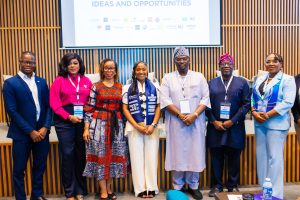
Elegbe urges entrepreneurs to build scalable businesses from Nigeria’s biggest gaps

Nigerian entrepreneurs should focus on solving the country’s most pressing economic and social problems while building businesses capable of scaling beyond their initial markets, Founder and Group Chief Executive Officer of Interswitch, Mitchell Elegbe, has said.
Elegbe said the combination of Nigeria’s large unmet needs and a young, expanding market presented significant opportunities for entrepreneurs who could convert local problems into commercially viable solutions.
He spoke at The Platform Nigeria 2026, organised by The Covenant Nation in Lagos, where business leaders and entrepreneurs examined how knowledge, execution and innovation could be used to build sustainable enterprises.
Speaking on the theme, “Dream BIG. EXECUTE with knowledge,” Elegbe said the size of an entrepreneurial ambition mattered less than the ability to execute effectively, learn from experience and build the systems required for expansion.
“Execution is more important than the size of the dream. But once you get it right, it’s called knowledge. It’s called experience. With experience, you can then scale,” he said.
Drawing from Interswitch’s development since its establishment in 2002, Elegbe said the company began by addressing a specific problem in Nigeria’s payments system before building the technology, partnerships and organisational capacity needed to expand its reach.
He urged entrepreneurs to adopt the same approach by starting with problems they understand deeply and developing solutions suited to the realities of their customers.
“When problems are local, solutions must be local. You have to understand the environment in which you are operating and design solutions that respond to the realities of your customers,” he said.
The entrepreneur warned that rapid growth should not be confused with sustainable scaling, stressing the importance of unit economics and business models capable of generating returns as operations expand.
He said entrepreneurs who intend to grow must make deliberate decisions from the beginning about people, technology, systems, partnerships and business structures.
“When you are starting small, start thinking about how to scale. The decisions you take at the early stages will affect your ability to scale, because you are laying the rails for the people, the systems, the architecture and the partnerships that will support the business later,” Elegbe said.
He also urged Nigerian entrepreneurs to adapt global ideas to local market conditions rather than simply reproduce models developed elsewhere.
Referencing the African business environment, he said entrepreneurs needed to “tropicalise” knowledge by combining international experience with local consumer behaviour, infrastructure realities and market dynamics.
“Silicon Valley is not the Tropical Savannah,” Elegbe said.
He identified food and agriculture, energy and clean cooking, healthcare, water and sanitation, and housing and construction as areas with significant potential for new businesses and investment.
According to him, entrepreneurs should look beyond immediate market conditions and consider the needs that will emerge over the next 25 years as Nigeria’s population and economy evolve.
“The opportunities are huge. The challenges are real, but do not allow the challenges to make you not think about the opportunities,” he said.
For Nigeria’s economy, the significance of the message extends beyond entrepreneurship. Businesses that successfully solve gaps in food production, energy, healthcare, housing and infrastructure can create jobs, attract investment, improve productivity and reduce some of the structural costs that continue to constrain growth.
Elegbe’s central argument was therefore that Nigeria’s economic transformation will depend not only on government policy, but also on entrepreneurs capable of turning the country’s persistent challenges into productive, scalable enterprises.
About The Author