Reforms, Rising Costs And The Battle To Build Competitive Enterprises
Temitope Adebayo
Nigeria’s economy is showing signs of recovery, but for many businesses, the distance between improving economic indicators and commercial success remains wide.
Economic growth is accelerating, inflation is moderating, and the Central Bank of Nigeria (CBN) has begun easing its monetary policy stance. Foreign investors are returning to selected Nigerian assets, while agriculture, digital services, domestic manufacturing and non-oil exports offer opportunities to broaden the country’s productive base.
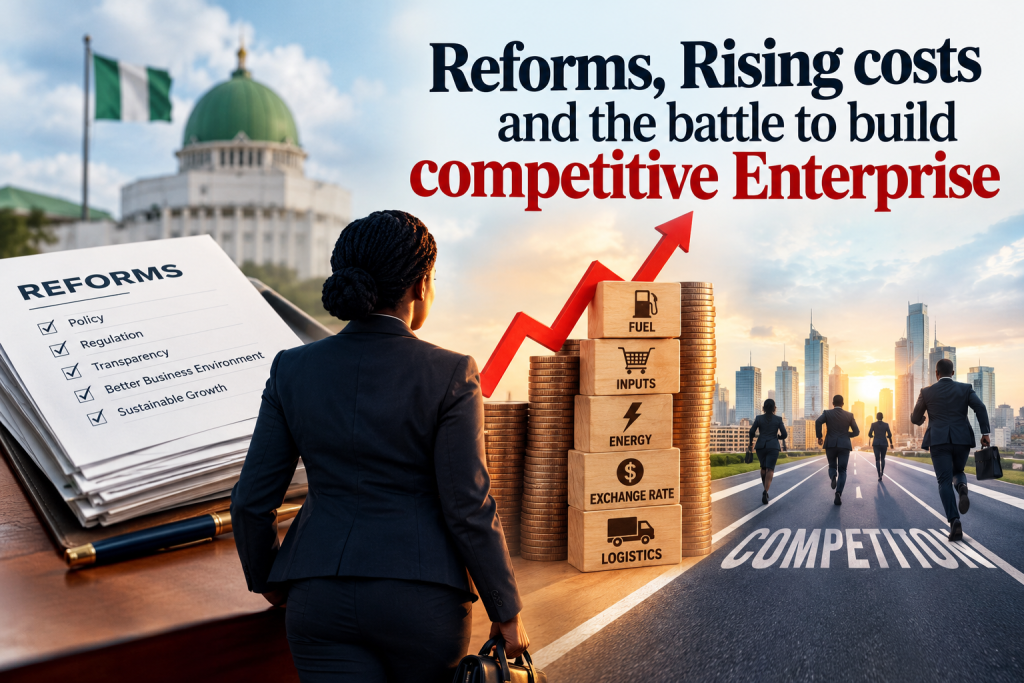
Yet, across the business environment, difficult questions persist. Can a small manufacturer obtain affordable credit to expand production? Can an agricultural processor move goods to market without losing its margins to transport and storage costs? Can a retailer maintain sales when consumers are struggling with higher living costs? And can Nigerian companies compete with imported products while paying heavily for electricity, financing and other essential inputs?
These questions define the real test of Nigeria’s economic recovery.
The reforms introduced since 2023 have sought to correct economic distortions, improve foreign exchange management, strengthen public finances and establish a more sustainable foundation for growth. But macroeconomic stabilisation does not automatically produce stronger enterprises.
The National Bureau of Statistics (NBS) reported that Nigeria’s real gross domestic product grew by 4.43 per cent in the second quarter of 2026, up from 3.89 per cent in the first quarter and 4.23 per cent in the corresponding quarter of 2025. The improvement points to stronger economic activity, although aggregate growth alone does not establish whether businesses are becoming more productive or creating enough jobs.
Inflation has also moderated. Headline inflation fell to 14.63 per cent in September 2026 from 15.39 per cent in August, while food inflation remained high at 19.59 per cent. The CBN reduced its Monetary Policy Rate (MPR) from 26.5 per cent to 23 per cent in September, signalling a shift towards less restrictive monetary conditions.
These developments are encouraging, but they do not erase the accumulated increase in business costs or restore household purchasing power to previous levels. A lower inflation rate means prices are rising more slowly; it does not mean goods and services have returned to what they cost before the inflationary surge.
For businesses selling directly to households, that distinction matters. Higher operating expenses collide with customers whose incomes may not have kept pace with prices. Companies must decide whether to increase prices, absorb the additional costs, reduce production or postpone expansion.
Each option carries consequences for profitability, investment and employment.
The Chief Executive Officer of the Centre for the Promotion of Private Enterprise (CPPE), Dr Muda Yusuf, has cautioned that Nigeria’s improving macroeconomic fundamentals have yet to translate into significant, broad-based improvements in productivity, competitiveness, employment and household welfare.
In his 2026 half-year economic review, Yusuf identified elevated production costs and persistent structural bottlenecks as continuing constraints on manufacturing, agriculture and micro, small and medium-sized enterprises (MSMEs).
He argued that the next phase of economic reforms must concentrate on lowering production costs, improving productivity, strengthening infrastructure and expanding access to affordable long-term financing.
The central economic question is therefore no longer simply whether Nigeria is stabilising. It is whether that stability can support a new phase of productive investment.
The Credit Wall: When Opportunity Meets Expensive Financing
Access to capital remains one of the most consequential constraints facing Nigerian enterprises.
A business may have a viable product, customers willing to buy and the capacity to increase output, yet remain unable to expand because financing is unavailable or too expensive.
This is particularly significant for MSMEs, which form a substantial part of Nigeria’s commercial landscape. The World Bank says MSMEs account for nearly half of the economy’s output and a large share of employment, yet fewer than one in 20 have access to bank credit. High borrowing costs, short loan tenures and collateral requirements continue to exclude many otherwise viable businesses.
The problem extends beyond the absence of loans. Businesses need financing that matches the purpose and timing of their investments.
A trader purchasing inventory may require short-term working capital. A food processor buying industrial equipment needs longer-term finance. An agricultural enterprise may require repayment arrangements that reflect seasonal production and sales.
When credit terms do not match these requirements, businesses can remain financially constrained even when lenders are willing to provide funds.
Nigeria’s monetary policy illustrates the tension. Although the CBN reduced its benchmark rate to 23 per cent in September, commercial lending rates do not automatically fall to that level. Banks must also account for funding costs, borrower risk, collateral, loan duration and administrative expenses.
The impact is substantial for enterprises seeking to purchase machinery, increase production capacity or enter new markets. Expensive financing can turn a potentially profitable investment into an unviable one.
It can also discourage businesses from investing in technology that would reduce production costs over time.
The Director-General of the Nigerian Employers’ Consultative Association (NECA), Adewale-Smatt Oyerinde, has drawn attention to what he describes as a liquidity paradox in the Nigerian economy: financial institutions may have substantial liquidity, yet productive businesses continue to struggle to obtain affordable credit.
In an April 2026 interview, Oyerinde pointed to the disparity between heavy investor demand for government securities and the financing difficulties confronting manufacturers and small businesses.
He also highlighted the high cost of borrowing, noting that some SMEs were paying as much as five per cent monthly to microfinance lenders, equivalent to approximately 80 per cent annually.
According to him, manufacturers require significantly cheaper financing to remain viable and expand production.
The concern is that when government securities offer attractive returns, while lending to smaller businesses carries greater perceived risks, financial institutions may have limited incentives to finance productive enterprises.
The Chairman of the Alliance for Economic Research and Ethics Ltd/GTE, Hon. Dele Kelvin Oye, has similarly identified inadequate credit allocation as a structural obstacle to enterprise development.
Oye has argued that Nigeria’s MSMEs require a financial system capable of assessing business cash flows, improving credit information and extending financing beyond companies with substantial conventional collateral.
His position reinforces the need for stronger credit guarantees, development finance, supply-chain financing and appropriate risk-sharing arrangements.
The World Bank’s Fostering Inclusive Finance for MSMEs in Nigeria programme offers one route towards addressing the problem. Approved in December 2025, the $500 million initiative is designed to expand access to finance for more than 250,000 small businesses, with 30 per cent of financing targeted at women-led enterprises.
The programme combines financing and risk-sharing arrangements intended to encourage financial institutions to lend to underserved businesses. Its value, however, must ultimately be assessed by the enterprises reached, the terms of the loans, the investments financed and the jobs created.
Funding announcements are not equivalent to credit reaching businesses.
The effectiveness of the intervention will depend on implementation, transparent reporting and evidence that viable enterprises are gaining access to financing they could not previously obtain.
Nigeria needs a financial system that supports productive investment without compromising prudent lending. This requires stronger credit information, credible business records, suitable collateral alternatives, credit guarantees and financing products designed around actual business cash flows.
Businesses also have responsibilities. Proper bookkeeping, credible financial statements and clear separation of personal and corporate finances can improve lenders’ ability to assess risks.
The objective is not to eliminate lending risks, but to ensure that viable businesses are not excluded simply because they lack substantial conventional collateral.
Electricity: The Hidden Tax On Production
For Nigerian businesses, electricity is not merely another overhead. It influences productivity, product quality, pricing and competitiveness.
Where grid supply is unreliable, companies must find alternative ways to maintain operations. Petrol and diesel generators, solar installations, battery storage and other backup systems help keep businesses running, but they require additional capital and can significantly increase operating expenses.
The burden is especially pronounced for manufacturers, food processors, cold-chain operators, bakeries and other businesses that need continuous electricity.
A company operating with reliable power can devote more resources to production, technology, staff development and expansion. Its Nigerian counterpart may have to divert scarce cash towards ensuring that its machines remain operational.
This creates a competitive disadvantage. A manufacturer facing high energy costs may struggle to match the prices of imported goods, particularly when foreign competitors operate with more reliable infrastructure or cheaper financing.
The scale of the challenge was highlighted by the Manufacturers Association of Nigeria (MAN) in October 2026, when its operators disclosed that energy costs now account for more than 40 per cent of manufacturing costs in Nigeria, compared with between five and 10 per cent in some competing African countries.
Chairman of the Manufacturers Power Development Company Limited, John Aluya, said the disparity was undermining industrial productivity and warned that manufacturers could not sustain a system in which they paid more for energy than distribution companies.
MAN Director-General, Segun Ajayi-Kadir, also said manufacturers were not receiving the electricity supply promised under the Band A classification, forcing many to depend on alternative power sources.
He put manufacturers’ expenditure on alternative electricity generation at approximately N1.34 trillion, underscoring the amount of capital being diverted from productive investments to keeping factories operational.
MAN President, Dr Ifeanyi Okoye, further identified access to finance as a major obstacle to manufacturers seeking to convert their machinery and production facilities to alternative energy systems.
The implication is that the electricity challenge cannot be addressed through tariff adjustments alone. Manufacturers require dependable supply, transparent billing and financing arrangements that make investments in energy efficiency commercially viable.
Energy inefficiency also reinforces the financing problem. A business spending heavily on alternative power has less cash available to purchase modern equipment. Without financing, it cannot easily invest in energy-efficient machinery. High operating costs then weaken the profitability required to attract additional investment.
Breaking this cycle requires more than increasing electricity generation. Nigeria needs reliable transmission and distribution infrastructure, better metering, improved commercial discipline across the electricity value chain and investment arrangements that support dependable service delivery.
Distributed renewable energy offers another opportunity, particularly for businesses in areas with weak grid supply. Solar and storage systems can reduce dependence on conventional generators, although their commercial viability depends on installation costs, financing terms and individual energy requirements.
For smaller enterprises, suitable financing arrangements could help spread the initial cost of efficient energy systems over time.
The economic test is straightforward: can businesses obtain dependable electricity at a price that allows them to produce competitively?
Until the answer improves substantially, electricity costs will continue to restrict investment and productivity across important segments of Nigeria’s economy.
Logistics: The Cost Of Moving Goods
Nigeria’s size and population provide a substantial domestic market, but poor transport connections, congestion, inadequate storage and expensive distribution can prevent businesses from accessing it profitably.
For farmers, transport and storage determine how much produce reaches consumers in saleable condition. For manufacturers, delays in receiving inputs can interrupt production and increase inventory costs. Retailers face additional expenses moving goods between warehouses, distribution centres and customers.
These inefficiencies eventually affect consumer prices.
A farmer may produce a marketable crop but lack access to storage, processing facilities or affordable transport. A processor may have the machinery to manufacture finished goods but struggle to secure consistent supplies of quality raw materials. A distributor may incur additional costs moving products through congested roads and fragmented supply chains.
The logistics problem is also affecting Nigeria’s export ambitions.
At the ninth Annual General Meeting of the MAN Export Group in September 2026, Chairman of the group, Ruth Owojaiye, called for concrete government action to address poor roads, expensive logistics, high interest rates and other production constraints affecting Nigerian exporters.
She argued that manufacturers needed to see tangible improvements in the operating environment rather than rely solely on monetary policy adjustments.
Owojaiye also called for the payment of outstanding Export Expansion Grant claims to enable exporters to reinvest the funds in their businesses, reduce production costs and improve competitiveness.
The export trade and logistics expert, Barrister Kolawole Awe, provided another indication of the burden, estimating that logistics costs account for between 26 and 30 per cent of the free-on-board value of Nigerian exports.
Such expenses increase the final price of locally manufactured goods and weaken their competitiveness against products from countries with more efficient transport systems.
The challenge is particularly significant under the African Continental Free Trade Area (AfCFTA), which offers Nigerian manufacturers access to a wider continental market but also exposes them to competition from producers operating with lower production and distribution costs.
Better infrastructure can reduce these costs and create opportunities beyond the transport sector itself.
Roads, railways, ports, warehouses, cold-chain facilities and agricultural processing centres can improve delivery times, limit spoilage and allow businesses to increase output without proportionately increasing distribution expenses.
But the economic return on infrastructure depends on project selection, execution and maintenance. The number of projects announced is less important than the bottlenecks they remove, the businesses they connect and the measurable improvements they deliver.
Transport and energy policies must also complement each other. A manufacturer cannot fully benefit from faster cargo delivery if unreliable electricity prevents it from increasing production. Likewise, improved agricultural output will have limited value if storage and logistics remain inadequate.
The highest returns will come when infrastructure investment addresses interconnected constraints rather than treating each project as an isolated intervention.
Agriculture And Manufacturing: Where Value Is Won Or Lost
One of Nigeria’s clearest opportunities lies in connecting agricultural production with domestic processing and manufacturing.
The country has a large consumer market and significant agricultural activity, but opportunities are lost when supply chains lack sufficient storage, processing, quality control and financing.
Moving beyond the sale of raw commodities can generate additional value through milling, drying, packaging, preservation and the production of finished goods. These activities create commercial opportunities for machinery suppliers, packaging manufacturers, logistics companies, cold-chain operators and retailers.
They can also strengthen domestic demand for locally produced inputs.
However, local sourcing cannot succeed through policy encouragement alone. Domestic suppliers must consistently deliver the quality, volume and pricing required by manufacturers.
Farmers need better seeds, suitable inputs, irrigation, extension services and access to markets. Processors need dependable raw materials, electricity, equipment and working capital. Distributors need efficient transport and storage.
When these elements work together, local sourcing can improve resilience and competitiveness. When they do not, manufacturers may find domestic inputs more expensive, inconsistent or unsuitable for their production requirements.
Policy should therefore focus on raising the productivity of local suppliers and making domestic value chains commercially viable.
The Managing Director of Amo Farm Sieberer Hatchery Limited, Ayoola Oduntan, has emphasised the importance of empowering farmers and developing local agricultural production as a foundation for Nigeria’s wider economic prosperity.
His position reflects an important industrial reality: domestic manufacturing cannot become competitive without reliable agricultural and raw-material supply chains.
The same opportunity extends to textiles, leather, construction materials, pharmaceuticals and household products. In each case, the objective is to develop businesses capable of competing on quality, cost and reliability, not merely to replace imports with more expensive local alternatives.
The wider economic benefits emerge when more value is retained locally through productive activity, skilled employment, technology transfer and stronger supplier networks.
Digital Innovation And The New Route To Growth
Digital technology offers another way for enterprises to overcome traditional barriers to expansion.
Digital payments, online marketplaces, electronic bookkeeping and inventory management systems can help businesses reach customers, improve record-keeping and make better commercial decisions.
For smaller enterprises, digital tools can reduce some of the costs associated with physical expansion while opening access to wider markets. Reliable digital records can also help businesses demonstrate their cash flows and establish a more credible financial history when applying for credit.
But digitalisation is not an automatic solution. Businesses still need affordable internet access, reliable electricity, appropriate skills and protection against fraud and cyber risks. Transaction charges and other platform costs can also weigh heavily on smaller merchants.
Public policy and financial institutions should therefore support affordable digital services, practical training and responsible competition among service providers.
The measure of success should be whether technology improves business performance: lower transaction costs, better records, wider market access and stronger productivity.
From Investment Announcements To Measurable Results
Nigeria’s policy challenge is not simply to announce more programmes, but to ensure that reforms translate into tangible improvements in the business environment.
The World Bank Group’s October 2026 assessment said it was helping mobilise up to $5.79 billion in private financing for Nigeria during its 2026 fiscal year. The initiative covers areas including digital infrastructure, agricultural value chains and finance for small businesses, using policy reforms, investment platforms and risk-sharing arrangements to attract capital.
The scale of the ambition is significant. But financing that may be mobilised should not be confused with funds already invested, nor does the headline amount establish how many businesses will expand or jobs will be created.
Those outcomes require separate measurement.
For credit programmes, the relevant indicators include the number and type of businesses financed, the terms offered, the distribution of beneficiaries and the investments supported.
For infrastructure projects, the tests should include improvements in electricity reliability, transport times, logistics costs and access to markets.
For tax reforms, assessments should consider the cost of compliance, the efficiency of revenue collection and the effect on formal business participation.
For industrial policies, the important measures include productivity, capacity utilisation, local sourcing, exports and employment.
Transparent reporting would help policymakers identify what works, correct shortcomings and direct public resources towards interventions with demonstrable economic returns.
This approach is particularly important when public money is used to guarantee loans, support infrastructure or attract private capital. Citizens and businesses should be able to assess whether those interventions are delivering the promised benefits.
The objective is to move economic debate away from the size of announcements and towards the quality of implementation.
What Must Change?
Nigeria’s enterprise-development agenda requires coordinated action across several areas.
First, productive finance must become more accessible. Credit guarantees, development finance, supply-chain financing and stronger credit information should help viable enterprises obtain funding suited to their cash flows.
Second, electricity must become more reliable and affordable. Investment in generation, transmission, distribution, distributed energy and efficiency should be linked to measurable improvements in service delivery and production costs.
Third, logistics inefficiencies must be reduced. Better transport infrastructure, storage and cold-chain facilities can lower losses, shorten delivery times and widen market access.
Fourth, business compliance should become simpler and more predictable. Clear regulations, coordinated administration and accessible digital services can lower the cost of formalisation without undermining public revenue.
Fifth, domestic value chains must become more productive. Local suppliers need support to meet commercial standards, improve efficiency and secure sustainable contracts with larger companies.
Sixth, skills and technology adoption must be linked more closely to industry requirements. Technical education, vocational training and digital skills should give workers the capabilities businesses need to expand.
Finally, policy implementation must be consistent and measurable. Businesses need predictable rules to plan investments that may take years to generate returns.
These priorities reinforce one another. Affordable credit is less effective when electricity is unreliable. Better roads cannot transform agricultural supply chains if storage remains inadequate. Tax simplification alone will not encourage formalisation if businesses lack finance and dependable public services.
Economic reforms are most effective when they reduce several constraints at once.
The Real Test Of Economic Recovery
Nigeria’s economic transformation will ultimately be judged by what its businesses can achieve.
Can a small manufacturer obtain financing to purchase modern equipment? Can an agricultural processor secure reliable raw materials and move finished products to market without losing a substantial share of its margins to avoidable costs? Can a young entrepreneur formalise a business, maintain credible records and obtain finance on reasonable terms? Can a domestic company compete with imported goods on quality, price and reliability?
These are central questions in the relationship between economic policy and national prosperity.
Nigeria has made progress towards addressing macroeconomic distortions and strengthening its economic framework. The acceleration of growth in the second quarter of 2026 and the moderation in headline inflation provide reasons for cautious optimism. But financing, energy, logistics and productivity constraints continue to limit the ability of many enterprises to expand.
The Chief Executive Officer of CPPE, Dr Muda Yusuf, has stressed that the quality of Nigeria’s economic management should increasingly be judged by whether structural reforms improve productivity and reduce the cost of doing business, rather than by macroeconomic stability alone.
That distinction captures the challenge confronting policymakers. A stronger economy must ultimately be reflected in stronger businesses, improved household welfare and more productive employment.
The next stage of reform must translate macroeconomic progress into stronger productive capacity.
That requires a business environment in which capital reaches viable enterprises, electricity supports production, transport networks connect businesses to markets, regulation rewards compliance and domestic suppliers can compete on commercial merit.
It also requires accountability for public programmes and a willingness to adjust policies when evidence shows that intended benefits are not reaching businesses.
The objective is not to shield every enterprise from competition or guarantee that every business succeeds. Companies must remain accountable for their financial discipline, product quality, management decisions and ability to respond to customers.
But competition can deliver its greatest benefits only when enterprises have a reasonable opportunity to access the infrastructure, finance, skills and markets needed to participate.
For policymakers, the task is to create those conditions. For banks, it is to expand responsible financing beyond businesses that already possess substantial assets. For larger companies, it is to build stronger commercial relationships with domestic suppliers. For entrepreneurs, it is to improve efficiency, embrace innovation and develop sustainable business models.
For Nigeria as a whole, the task is to ensure that economic reform produces more than improved headline indicators.
The real measure of recovery is whether Nigerian businesses can produce more, employ more people, compete more effectively and create lasting value without being held back by avoidable economic constraints.
Until that happens on a broad and sustained scale, the great Nigerian business survival test will remain unfinished.
About The Author