Dangote bets $60bn on Africa, opens new energy front in Namibia
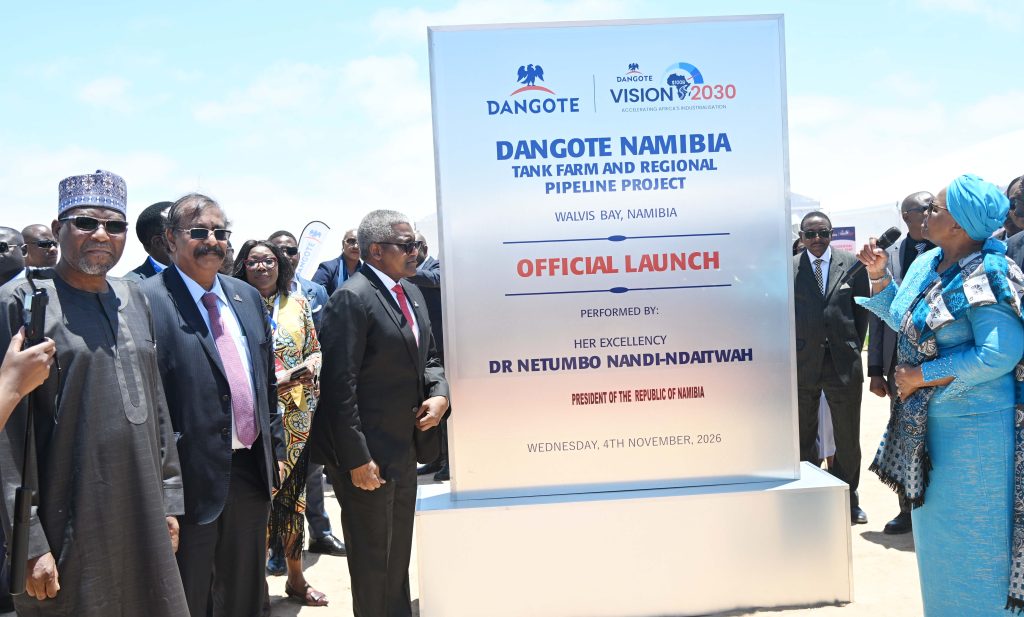
Aliko Dangote, President of Dangote Group, has raised the conglomerate’s investment target for Africa from $50 billion to $60 billion by 2030, signalling an expansion of its industrial and energy infrastructure ambitions across the continent, with a new $2.5 billion fuel storage and pipeline project in Namibia marking a major step in the drive.
The revised investment target, announced on Wednesday, November 4, 2026, at the groundbreaking ceremony for the Namibia project near Walvis Bay, represents a 20 per cent increase in the Group’s original commitment and underscores Dangote’s growing ambition to position his business empire at the centre of Africa’s industrialisation and energy supply chains.
According to Bloomberg, the Namibia project will comprise a fuel storage facility with a capacity of about four million barrels and a 1,700-kilometre pipeline extending through Botswana and South Africa, creating a regional petroleum distribution corridor designed to improve supply efficiency and reduce transportation costs, particularly for landlocked countries.
Speaking at the ceremony, Dangote said the Group was translating its continental expansion ambitions into tangible investments rather than relying on announcements and commitments.
“We also put our money on the table — it’s not just about saying things,” he told reporters in Walvis Bay, adding that the Group was planning an even larger investment programme between 2030 and 2035.
He said the project would make petroleum products more accessible and affordable across the region, particularly in countries without direct access to seaports.
“We want to heavily invest so that most of the landlocked countries will be able to access petroleum products at a cheaper price,” he said.
The proposed storage facility will include 360 million litres of diesel storage and 240 million litres of gasoline capacity, with construction expected to be completed within 18 months, according to Dangote.
Beyond strengthening Namibia’s domestic fuel supply, the pipeline infrastructure is expected to improve cross-border petroleum distribution, reduce dependence on costly road transportation and create opportunities for more competitive fuel pricing across southern Africa.
The investment also highlights the growing importance of private-sector infrastructure financing in addressing Africa’s energy distribution challenges, where inadequate pipelines, limited storage capacity and fragmented supply networks have continued to increase the cost of moving petroleum products between markets.
For Dangote Group, the Namibia project represents another major component of an increasingly ambitious continental energy strategy, supported by plans to expand refining capacity, develop petroleum storage terminals and establish strategic distribution corridors across Africa.
The conglomerate has announced more than $35 billion in infrastructure investments this year, representing a substantial portion of its previous $50 billion target for Africa by 2030.
At the centre of the expansion is the planned increase in the capacity of the Dangote Petroleum Refinery in Lagos from 650,000 barrels per day to 1.4 million barrels per day within three years.
The Group is also pursuing an extensive petroleum distribution network across East, Central and Southern Africa, with investments in pipelines and storage facilities intended to address supply bottlenecks and reduce the continent’s dependence on long-distance fuel transportation.
Dangote’s latest investment ambition comes at a time when African economies are seeking greater energy security, stronger regional trade integration and increased domestic industrial capacity.
If successfully implemented, the Namibia infrastructure project could strengthen the Group’s influence in the regional petroleum market while opening new commercial opportunities in fuel storage, transportation and distribution.
For Nigeria, the expansion also carries strategic significance, as the Dangote industrial model increasingly takes Nigerian-owned capital, refining capacity and infrastructure expertise beyond domestic borders into other African markets.
Editorial note: Before publication, the $2.5 billion project cost, four-million-barrel storage capacity and pipeline route should be independently verified against the original Bloomberg report and project documentation.
About The Author