BOI targets 10% of financing for green projects, mobilises €100m climate fund
The Bank of Industry (BOI) is targeting at least 10 per cent of its financing interventions towards climate and sustainability-focused projects by 2027, as rising energy costs and growing environmental pressures push Nigerian manufacturers towards cleaner and more efficient production systems.
The commitment, contained in the bank’s 2025–2027 strategy, is expected to channel more financing into renewable energy, climate-smart agriculture and energy-efficient manufacturing, potentially reducing operating costs and improving the competitiveness of local industries.
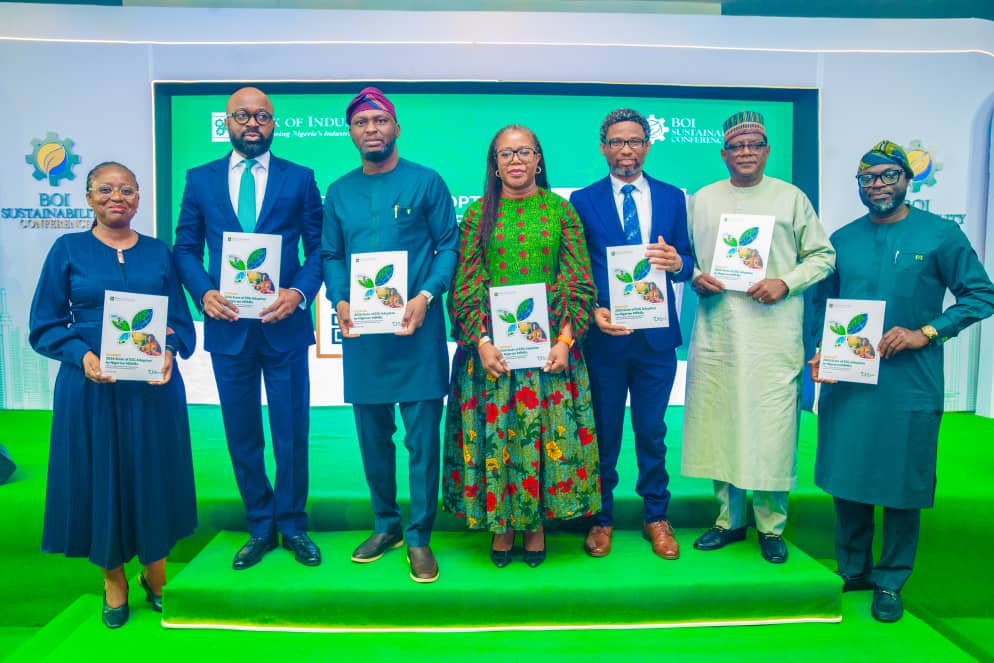
BOI Managing Director and Chief Executive Officer, Dr Olasupo Olusi, disclosed this at the second edition of the bank’s Sustainability Conference in Lagos on Wednesday, where he called for stronger partnerships among government, financial institutions, development partners and private businesses to accelerate Nigeria’s green industrial transition.
The conference, themed Green, Resilient, Profitable: Redefining Nigerian Businesses for a Sustainable World, focused on mobilising sustainable finance, improving industrial efficiency and integrating environmental, social and governance (ESG) standards into business operations.
Olusi said manufacturers were increasingly challenged by high energy costs, dependence on alternative power generation, climate-related disruptions and inefficient production systems, making sustainability a critical factor in business survival and profitability.
He argued that investment in renewable energy, energy-efficient equipment and cleaner production technologies could lower operating expenses, improve productivity and strengthen the ability of Nigerian businesses to compete in domestic and international markets.
According to him, BOI is working with development partners, including the Deutsche Gesellschaft für Internationale Zusammenarbeit (GIZ) and the Africa Guarantee Fund, to mobilise climate finance, reduce investment barriers and support businesses adopting sustainable practices.
However, he stressed that financing alone would not deliver the transition, urging businesses to strengthen governance, embrace innovation and integrate sustainability into their long-term investment decisions.
The financing challenge was also highlighted by Nigeria Country Manager of Agence Française de Développement (AFD), Jackie Amprou, who disclosed that the agency’s partnership with BOI under the Transforming Financial Systems for Climate programme included a €100 million credit facility and a €2.5 million technical-assistance grant.
The €100 million facility, co-financed by AFD and the Green Climate Fund, is designed to support climate mitigation and adaptation projects, while the grant will strengthen BOI’s climate strategy, environmental and social management systems, climate-risk assessment and capacity to identify bankable green investments.
Amprou said strong environmental and social performance had become increasingly important in the financial system but warned that meeting ESG standards did not automatically guarantee access to funding.
He identified weak project bankability, inadequate institutional and technical capacity, and actual or perceived financial risks as major obstacles preventing businesses from accessing sustainable finance.
“We must move beyond simply rewarding green performance. We must actively finance green transformation,” he said.
He added that technical capacity developed through the partnership had helped BOI access a separate $30 million AFD credit facility for Nigeria’s creative industries, demonstrating the wider financing opportunities that could emerge from stronger institutional capacity.
Speaking on behalf of the Federal Ministry of Industry, Trade and Investment, its Permanent Secretary, Dr Christopher Isokpunwu, described sustainability as an increasingly important determinant of access to capital, operational efficiency, market access and long-term business competitiveness.
He said Nigeria’s ambition to build a $1 trillion economy must be supported by industries that are more productive, innovative, resilient and globally competitive.
According to him, manufacturers investing in renewable energy could reduce operating costs and protect profit margins, while agribusinesses adopting circular production, resource efficiency and waste reduction could strengthen domestic value chains.
He urged BOI to expand green financing and technical assistance without excluding small and medium-sized enterprises, noting that access to credible ESG data was essential for effective policymaking and targeted financing interventions.
The conference also featured the presentation of the second edition of the State of ESG Adoption Report, produced in partnership with Lagos State Business School, providing data-driven insights into the adoption of sustainability practices among Nigerian businesses.
Beyond financing commitments, BOI said its climate interventions include its accreditation as Nigeria’s first implementing entity under the Adaptation Fund, giving it access to up to $25 million for climate adaptation projects across the country.
The bank is also expanding clean-energy access through its Solar Energy Programme and has financed Nigeria’s first 11-megawatt solar power plant for a steel manufacturer, demonstrating the potential of renewable energy to support industrial production.
The developments highlight the growing importance of development finance institutions in bridging Nigeria’s green investment gap, particularly as manufacturers seek alternatives to expensive conventional energy sources and prepare for changing global environmental and market requirements.
For Nigerian businesses, the central challenge will be converting sustainability commitments into commercially viable projects capable of attracting financing, reducing production costs and generating measurable returns.
About The Author