Nigeria’s economy accelerates to 4.43% as agriculture, services power Q2 growth
Nigeria’s economic expansion strengthened in the second quarter of 2026, with real Gross Domestic Product (GDP) growth rising to 4.43 per cent year-on-year, as stronger agriculture and services activity more than offset a sharp slowdown in the industrial sector.
The latest figure from the National Bureau of Statistics (NBS) represents a 0.20 percentage-point improvement from the 4.23 per cent recorded in Q2 2025, pointing to a modest acceleration in economic activity.
The performance also marks an improvement over the 4.07 per cent growth recorded in Q4 2025, although the expansion remains uneven across major sectors.
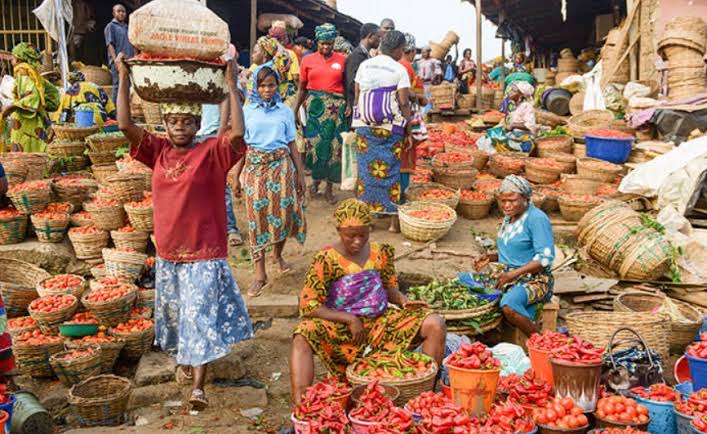
Agriculture emerged as one of the strongest drivers, expanding 4.39 per cent in real terms, compared with 2.82 per cent in Q2 2025 and 3.15 per cent in Q1 2026.
The sector also recorded a strong 17.80 per cent quarter-on-quarter expansion and accounted for 26.15 per cent of real GDP during the quarter.
Services remained the fastest-growing of the three major sectors, expanding 4.60 per cent year-on-year, up from 3.94 per cent a year earlier.
Industry, however, lost momentum significantly, with growth slowing to 3.96 per cent from 7.46 per cent in Q2 2025.
In nominal terms, the economy expanded much faster, with aggregate GDP rising to N119.29 trillion in Q2 2026 from N100.73 trillion in the corresponding period of 2025.
That represents an 18.43 per cent year-on-year increase, reflecting both higher economic activity and price changes.
The oil sector also delivered stronger output, despite its growth rate slowing considerably from a year earlier.
Nigeria’s average daily crude oil production increased to 1.72 million barrels per day in Q2, from 1.68 million bpd in Q2 2025 and 1.55 million bpd in Q1 2026.
Real oil-sector growth stood at 7.31 per cent year-on-year, compared with a much stronger 20.46 per cent in Q2 2025, but well above the 2.57 per cent recorded in Q1 2026.
On a quarter-on-quarter basis, the oil sector expanded 10.91 per cent.
Oil’s contribution to real GDP rose to 4.16 per cent, from 4.05 per cent a year earlier and 3.92 per cent in Q1.
More significant for the structure of the economy was the performance of the non-oil sector, which expanded 4.31 per cent year-on-year, compared with 3.64 per cent in Q2 2025 and 3.94 per cent in Q1 2026.
The NBS attributed the expansion to activity across agriculture, information and communication, real estate, trade, financial and insurance services, manufacturing and construction.
The latest growth figures come amid improving international assessments of Nigeria’s economic trajectory.
The World Bank has upgraded its 2026 growth estimate to 4.4 per cent, while maintaining a 4.4 per cent forecast for 2027.
The International Monetary Fund, however, has taken a more cautious view, cutting its 2026 growth forecast by 0.3 percentage points to 4.1 per cent, citing mounting global and domestic pressures.
Nigeria has also recently received improved assessments from international financial institutions. Moody’s moved the country’s sovereign outlook from stable to positive, citing stronger foreign reserves and improving economic performance, while S&P Global Ratings upgraded Nigeria’s sovereign rating to B from B-.
Nigeria’s external position has strengthened alongside the economic expansion, with foreign reserves reaching $53.11 billion as of August 24, 2026, after rising by $7.09 billion since the beginning of the year.
Higher crude production and stronger oil prices linked to geopolitical tensions have helped strengthen external earnings, although continued exposure to global oil-market volatility remains a risk.
The latest Q2 figures therefore present a mixed economic picture: growth is accelerating, agriculture and services are expanding and crude production is improving, but industrial growth has weakened significantly.
For policymakers, the central challenge is now to turn the 4.43 per cent headline expansion into stronger investment, manufacturing output, household incomes and job creation.
The bigger test is whether Nigeria can sustain growth above 4 per cent while strengthening the industrial base and ensuring that improving macroeconomic indicators translate into broader gains for businesses and households.
About The Author