Afreximbank backs Africa trade with $500m facility as AfCFTA faces logistics bottlenecks
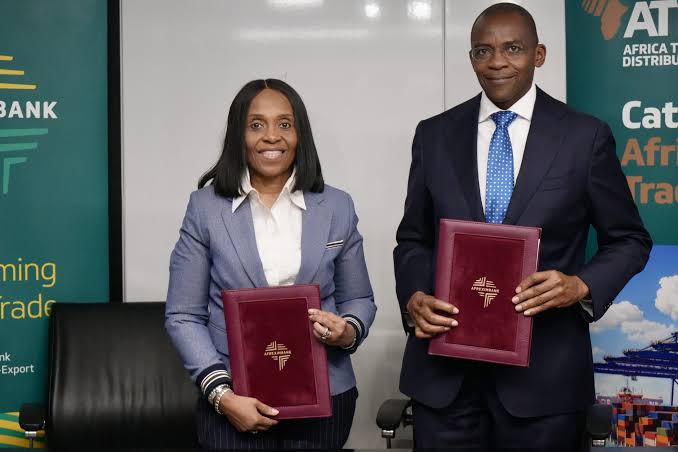
The African Export-Import Bank (Afreximbank) and the Africa Trading and Distribution Company (ATDC) have signed a $500 million Global Credit Facility to finance the movement of African goods across borders, targeting one of the biggest constraints to the continent’s effort to expand intra-African trade.
The facility will provide working capital for the purchase and aggregation of commodities, while also financing transportation, warehousing, logistics and distribution across different stages of the trade cycle.
For African producers, the intervention is significant because access to markets is often constrained not only by production capacity but by the ability to finance inventory, move goods across borders and secure reliable distribution networks.
Afreximbank’s Executive Vice-President for Intra-African Trade and Export Development, Kanayo Awani, said the facility would help build the trade and logistics infrastructure required to realise the potential of the African Continental Free Trade Area (AfCFTA).
She said financing the movement of African-made goods would deepen regional value chains, improve market access for producers and support the growth of manufactured exports.
ATDC Chief Executive Officer, Stewart Makura, said the facility would strengthen the company’s ability to aggregate supply, mobilise working capital and connect producers, processors, manufacturers and consumers across African markets.
“Together with Afreximbank, we will support stronger supply chains, value addition, import substitution and intra-African trade,” he said.
ATDC currently has operations in Egypt, Nigeria, Malawi and Zimbabwe, giving the facility an immediate footprint across different African markets.
Beyond financing individual transactions, Afreximbank said the facility is expected to help ATDC develop repeatable trade corridors and expand access to dependable sourcing and distribution networks, while increasing the availability of raw materials, industrial inputs and value-added products across the continent.
The intervention comes against the backdrop of a persistent trade-finance gap across Africa. Afreximbank’s African Trade Report 2025 estimated the continent’s trade-finance gap at about $100 billion, even as intra-African trade rebounded strongly in 2024 to $220.3 billion.
That financing shortage has significant economic consequences. Businesses may have products to sell but lack the working capital required to buy stock, aggregate supply, transport consignments or hold inventory while waiting for payment.
For agricultural producers in particular, stronger aggregation and distribution networks could help reduce market fragmentation, improve access to larger buyers and create incentives for processing instead of exporting raw commodities.
The facility could also support import substitution by making it easier to source African-made raw materials and finished products within the continent instead of relying on suppliers outside Africa.
That is central to the industrialisation objectives of AfCFTA. Afreximbank says stronger intra-African value chains can help African businesses move from commodity exports towards higher-value manufacturing and processing.
The economic opportunity is substantial. Afreximbank’s latest trade data show intra-African trade rose 12.4 per cent to $220.3 billion in 2024, although it still represented only 14.4 per cent of Africa’s total trade.
The $500 million facility therefore comes at a critical point in the implementation of the continental free-trade agreement. Lowering tariffs alone cannot create an integrated African market if producers cannot access finance, transport goods efficiently or reach consumers in other countries.
For Nigeria and other major African economies, the larger prize is a trading system in which locally produced goods can move across borders at commercially viable costs, creating markets for manufacturers, farmers and processors while retaining more value within the continent.
The success of the facility will ultimately depend on how much trade it finances, how many new trade corridors it establishes and whether the resulting flows encourage more African production, processing and value addition.
About The Author