FG freezes tariff, targets 500,000 jobs as power sector reset gains momentum
Nigeria’s power sector reform agenda is accelerating, with the Federal Government ruling out any immediate electricity tariff hike while unveiling a comprehensive plan to stabilise supply, expand metering, and restore investor confidence. This critically examines how the resolution of a long-standing dispute with local meter manufacturers has unlocked the deployment of 1.56 million meters before year-end, part of a broader target of 7 million meters in three years.
At the same time, the government is rolling out the Power Force initiative, designed to train up to 500,000 young Nigerians for jobs in the electricity industry. This dual-track strategy combining sector reform with employment creation signals a reset aimed at transforming electricity from a constraint on economic activity into a catalyst for national productivity, industrialisation, and growth.
This improved introduction sets the stage for a power sector reset analysis, weaving together tariff stability, metering breakthroughs, youth employment, and grid reforms into a front-page economic story.
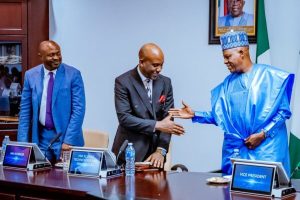
Minister of Power Joseph Tegbe clarified that tariff increases are not on the table, stressing that the administration’s priority is to improve supply, strengthen transmission infrastructure, expand metering, and protect vulnerable consumers. “Our priority is service improvement, universal metering and ensuring Nigerians pay only for the services they receive,” he said.
Metering Breakthrough and Jobs Creation
The resolution of a legal dispute with the Association of Meter Manufacturers of Nigeria (AMMON) cleared the way for the rollout of 1.56 million smart meters before December, ending months of stalled procurement. Tegbe said the settlement balances President Tinubu’s “Nigeria First” policy with the need to meet national metering demand through a blend of local and international procurement.
The metering programme is central to eliminating estimated billing, which has long eroded trust between consumers and providers. By linking metering to youth training, the government is creating a skilled workforce to support the long-term development of the electricity industry. Already, 5,000 youths have been trained in meter installation and electrical engineering, with plans to expand to 500,000.
Grid Stabilisation and Liquidity Reform
Beyond metering, Tegbe announced strategic investments in three critical transmission corridors, Lagos, Enugu-Port Harcourt, and Abuja-Kaduna-Kano, under a Grid Stabilisation Programme. A Super Grid Programme is also planned to strengthen Nigeria’s transmission backbone, improve redundancy, and enable evacuation of higher volumes of electricity.
The minister emphasised that Nigeria’s power crisis is 80% about liquidity, governance, and commercial inefficiencies, not technical deficiencies. Collection losses approaching 40% and tariff shortfalls have weakened operators’ financial positions. To address this, the government is advancing a Power Sector Bond Initiative to clear legacy debts owed to generation companies and gas suppliers, restoring liquidity and investor confidence.
Renewables and Rural Electrification
The reform agenda also includes expanding rural electrification through the Rural Electrification Agency (REA), with mini-grids already deployed in universities and hospitals. A new phase will extend power to institutions such as the University of Lagos and University College Hospital, Ibadan. Tegbe said renewable energy will play a growing role, with solar targeted to contribute 40% of Nigeria’s energy mix by 2060.
Positive Outlook: Reform Meets Discipline
Nigeria has consistently generated about 5,000MW in recent weeks, a milestone Tegbe described as progress, though not the final destination. He stressed that generation alone cannot solve the country’s electricity challenges: “Electricity must be generated, transmitted, distributed and importantly, paid for. All these components must function simultaneously.”
The government expects visible improvements in electricity availability within months, with a stronger grid and improved market discipline within two to three years. By freezing tariffs, unlocking metering, creating jobs, and tackling liquidity, the administration is positioning electricity as a catalyst for productivity, industrialisation, and investment.
This package of reforms, tariff stability, metering rollout, youth employment, grid upgrades, and liquidity restoration, marks one of the most comprehensive resets of Nigeria’s power sector in decades
About The Author