NASS urges SEC to exceed 2026 revenue target by 20%
NASS
The National Assembly has commended the Securities and Exchange Commission (SEC) for strengthening its fiscal sustainability through improved revenue generation and cost-cutting measures, while challenging the capital market regulator to surpass its 2026 revenue target by at least 20 per cent.
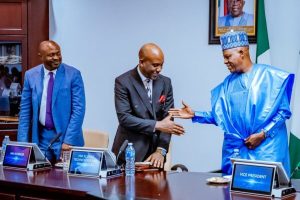
The commendation came on Tuesday during the 2026 Revenue Monitoring Exercise with the Commission in Abuja, where the Deputy Chairman of the House of Representatives Committee on Finance, Hon. Saeed Musa Abdullahi, praised the SEC’s financial discipline and operational performance.
Abdullahi said the Commission had demonstrated remarkable progress in improving its finances despite the country’s fiscal challenges, stressing that the monitoring exercise was intended to encourage better performance rather than scrutinise agencies.
“DG, you have done significantly well. We have followed the progress of the SEC over the years and urge you to keep the flag flying. We will continue to celebrate you when you do well. This exercise is not to witch-hunt any agency; it is aimed at ensuring better performance, especially at a time when the country is facing serious fiscal challenges,” he said.
He urged the Commission to exceed its projected revenue for the year, saying it had the capacity to deliver stronger results.
“You have told us your revenue projection for 2026, but we believe you can do more. We urge you to surpass your projection by at least 20 per cent, or even more,” Abdullahi added.
Responding, the Director-General of the SEC, Dr Emomotimi Agama, said the Commission operates without budgetary allocations from the Federal Government, relying entirely on internally generated revenue from Nigeria’s capital market while still remitting funds to government.
Agama explained that the arrangement aligns with the principles of the International Organization of Securities Commissions (IOSCO), which require securities regulators to maintain operational independence.
“Going by IOSCO principles, the SEC is expected to be financially independent. The government is supposed to provide support for the running of the Commission. However, due to the paucity of funds, all the money used to fund the Commission comes from the market. The SEC does not receive any funding from the government; rather, it pays money to the government,” he said.
He disclosed that revenues paid into the Commission’s account with the Central Bank of Nigeria are subjected to statutory deductions before the SEC can access the funds.
“When these funds hit our account with the CBN, deductions are made directly by the government. We do not have access to the funds before the deductions are effected,” Agama said.
To sustain its operations without imposing additional financial burdens on market operators, Agama said the Commission secured approval from the Minister of Finance to retain 20 per cent of its internally generated revenue.
“We are regulators and are not expected to ask the market for money. With the kind permission of the Honourable Minister of Finance, we obtained a 20 per cent waiver on deductions to ensure our operations are not hindered,” he stated.
The SEC Director-General also announced that the Commission had secured a grant from the African Development Bank to acquire a modern market surveillance system expected to be deployed later this year.
According to him, the new technology will strengthen regulatory oversight, improve market integrity and align Nigeria’s capital market with international best practices.
About The Author